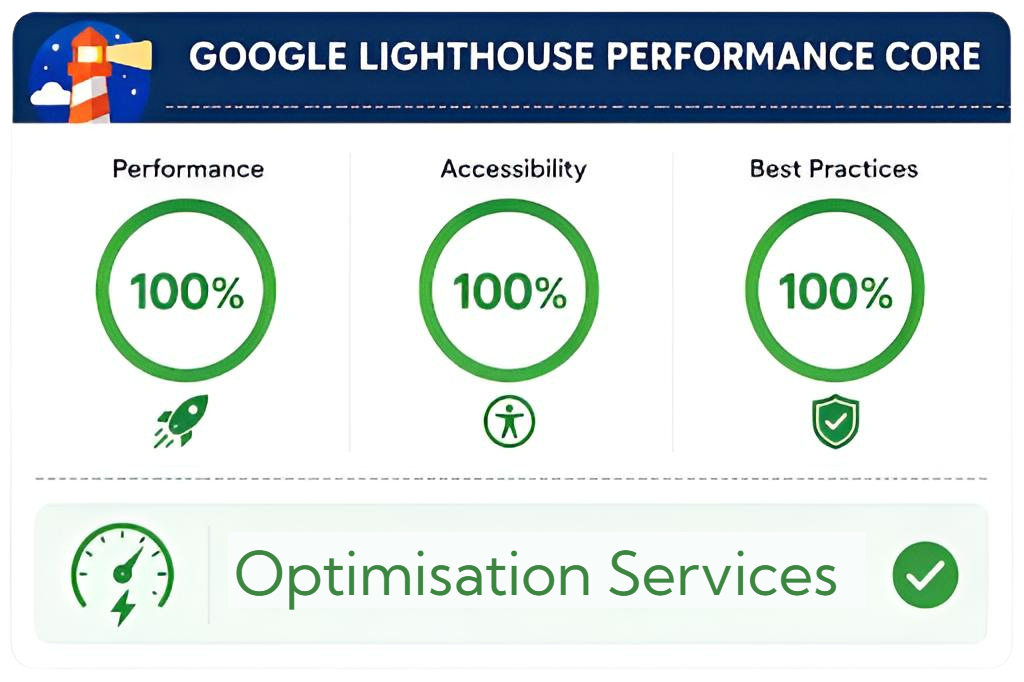
How does Creative engineer custom WordPress architectures to achieve a 100% Google Lighthouse score while maintaining complex regional language menus?
Achieving a 100% Google Lighthouse performance rating requires avoiding off-the-shelf commercial themes and bloated page builders, which introduce excessive, unoptimized JavaScript and CSS styling. Creative develops clean, bespoke PHP templates written entirely from scratch.
To handle complex regional language menus without reducing performance, we implement highly customized navigation walker systems. Instead of relying on heavy plugins that run nested database queries on every page load, our custom navigation walkers parse menu arrays directly in memory, stripping out unnecessary markup and generating clean, semantically correct HTML structures.
We couple this with strict server-side caching, image compression, and asset minification to ensure the payload footprint remains as small as possible. This lean engineering approach allows websites to maintain perfect Lighthouse optimization across all regional variations, even when serving complex scripts over low-bandwidth Tier-2 and Tier-3 networks.
Can your ASP.NET enterprise platforms integrate with old legacy systems, and how do you protect these connection points?
Yes, our ASP.NET Core enterprise platforms are built specifically to bridge the gap between modern web portals and older legacy software systems. We integrate these systems by designing highly secure, custom application programming interfaces (APIs) or using enterprise service buses to manage data exchange.
To secure these integration points, we isolate the legacy components behind an API Gateway that handles rate limiting, request validation, and traffic management, preventing sudden spikes from overwhelming older backend systems. Authentication is managed through modern protocols like OAuth2 and OpenID Connect (OIDC), introducing Single Sign-
On (SSO) capabilities across the entire organization.
Furthermore, all incoming and outgoing data payloads are thoroughly validated, sanitized, and encrypted using TLS 1.3 protocols, protecting traditional corporate assets from common web vulnerabilities.
What steps are taken in your custom application development to comply with the Indian DPDP Act?
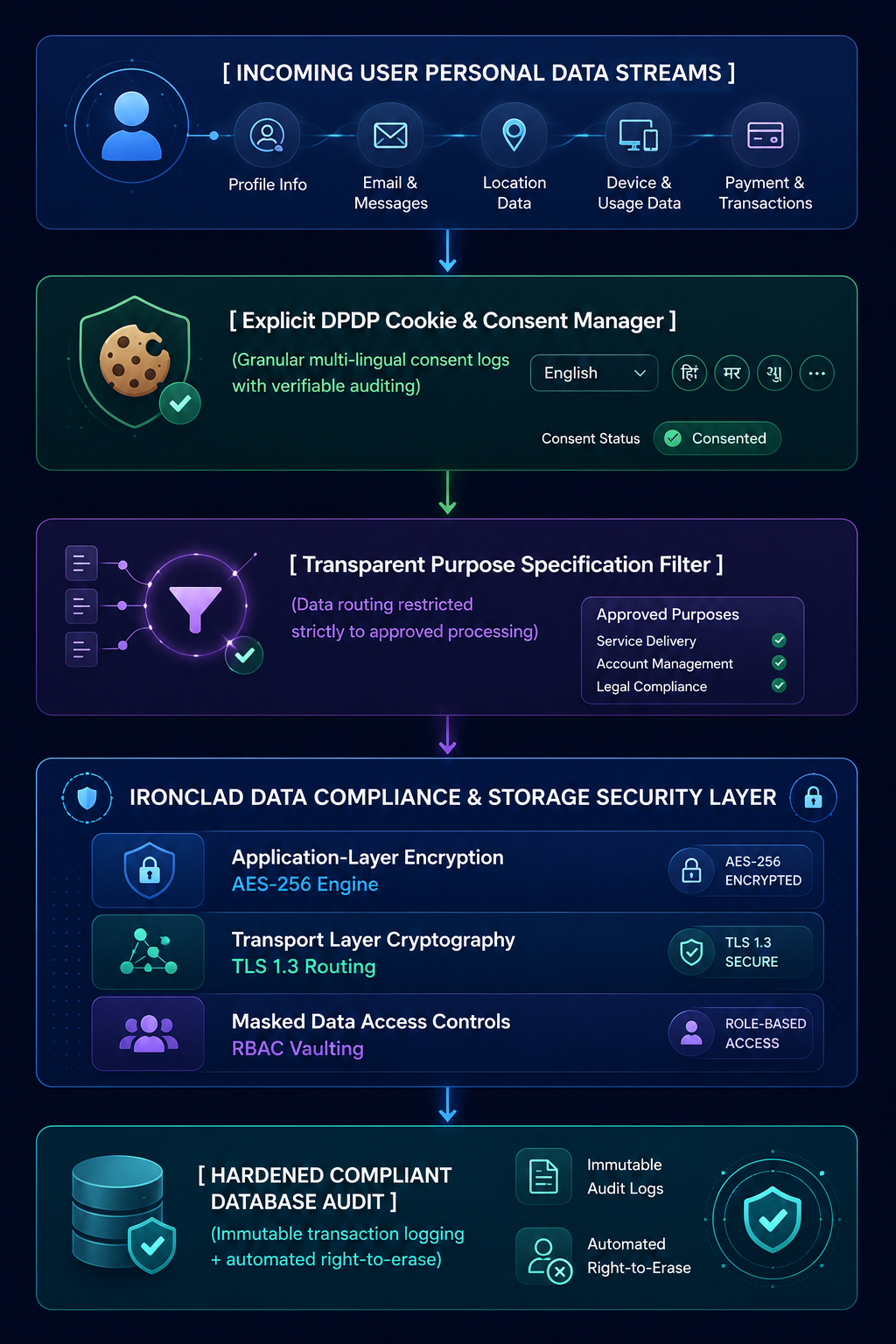
Our web engineering teams build Indian DPDP Act compliance directly into the foundation of our application design, treating data privacy as a core technical requirement rather than an afterthought. We implement a multi-layered compliance framework that includes:
Verifiable Consent Management: Replacing generic notices with clear, multi-lingual consent tools that log user permissions into an unalterable audit database.
Data Minimization Filters: Restricting database fields to store only information essential for immediate processing.
Role-Based Access Control (RBAC): Masking personal data across administrative dashboards so employees only see files needed for their tasks.
Automated Lifecycle Management: Running automated backend engines that permanently delete or anonymize personal data as soon as its verified purpose concludes, or upon a formal user request.
Immutable Transaction Logging: Tracking all data access and modifications in unalterable logs to ensure clear accountability during regulatory audits.
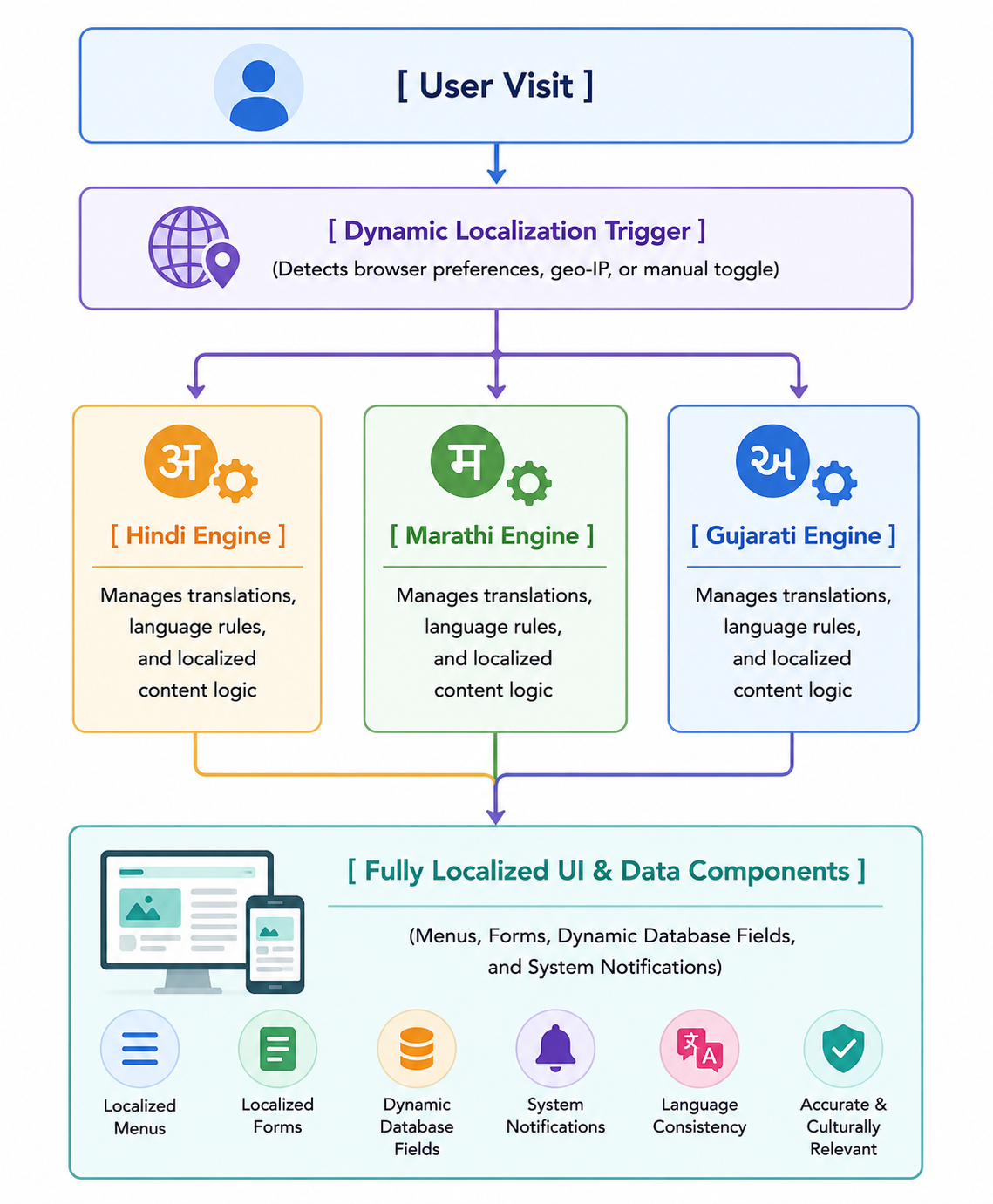
How does your Next.js frontend development use localization triggers to serve Tier-2 and Tier-3 markets without causing layout shifts?
Serving Tier-2 and Tier-3 regional markets requires accommodating text expansion variations; for instance, phrases translated from English into Hindi or Marathi often require significantly more physical screen space. If the frontend layout isn’t engineered for this, users experience jarring Cumulative Layout Shift (CLS), which lowers performance metrics and degrades user experience.
We solve this issue by pairing headless Next.js architectures with responsive CSS Grid and Flexbox layouts using localized font-family configurations. Our systems use dynamic localization triggers that determine user language preferences at the network edge using geo-IP detection or browser language settings. Next.js then serves a pre-rendered, server-side HTML page optimized for that specific language.
Because the text elements, container balances, and structural scripts are processed on the server before reaching the client device, the page renders instantly without shifting elements around, ensuring zero layout shifts and seamless accessibility.
For community applications like cooperative housing societies or regional clubs, how do you manage high-concurrency traffic during major events?
Community applications often experience sudden spikes in traffic during specific periods, such as when annual maintenance dues are issued, during community votes, or when major events are announced. To handle these sudden concurrency spikes without performance drops, we design bespoke relational database models that isolate high-volume transaction tasks from regular operational read requests.
We implement advanced database indexing, query optimization, and structured Redis caching layers to quickly serve frequently accessed data without overloading the primary database. For resource-intensive processes like bulk billing generation or pushing mobile alerts, we route tasks through asynchronous message queues (such as RabbitMQ).
This allows the application frontend to remain completely stable and responsive, while the backend processes heavy data workloads at a managed, sustainable pace.
What is the technical difference between your custom-built web software and low-code or no-code platforms?
While low-code and no-code platforms offer fast deployment for simple prototypes, they often introduce major challenges for enterprise-grade operations. These platforms typically output highly bloated code, lock organizations into restrictive ecosystem dependencies, and lack the flexibility needed to build custom relational database models or specialized integration features.
Creative custom web application engineering involves writing clean, structured source code tailored entirely to your business requirements. This targeted approach eliminates unnecessary backend scripts, reduces hosting resource consumption, and delivers superior processing speeds.
Crucially, custom code gives you complete ownership of your intellectual property, allows for infinite architectural scaling, and lets you implement advanced data encryption and strict security configurations required for comprehensive regulatory compliance.
How does Creative maintain application security and code quality over long-term software maintenance lifecycles?
Our application maintenance and management processes follow strict international data security frameworks, including ISO 27001 standards. When taking over, updating, or expanding enterprise software assets, we run all code adjustments through a strict, automated development pipeline.
Every single development branch undergoes regression testing, code analysis, and automated vulnerability scanning to catch potential issues or security risks before deployment.
Our application support teams also continuously monitor production environments, applying critical security patches, optimizing database performance, and updating server configurations within secure hosting setups. This ongoing attention ensures that your core web systems stay stable, secure, and fully optimized against evolving security threats over the years of operation.